
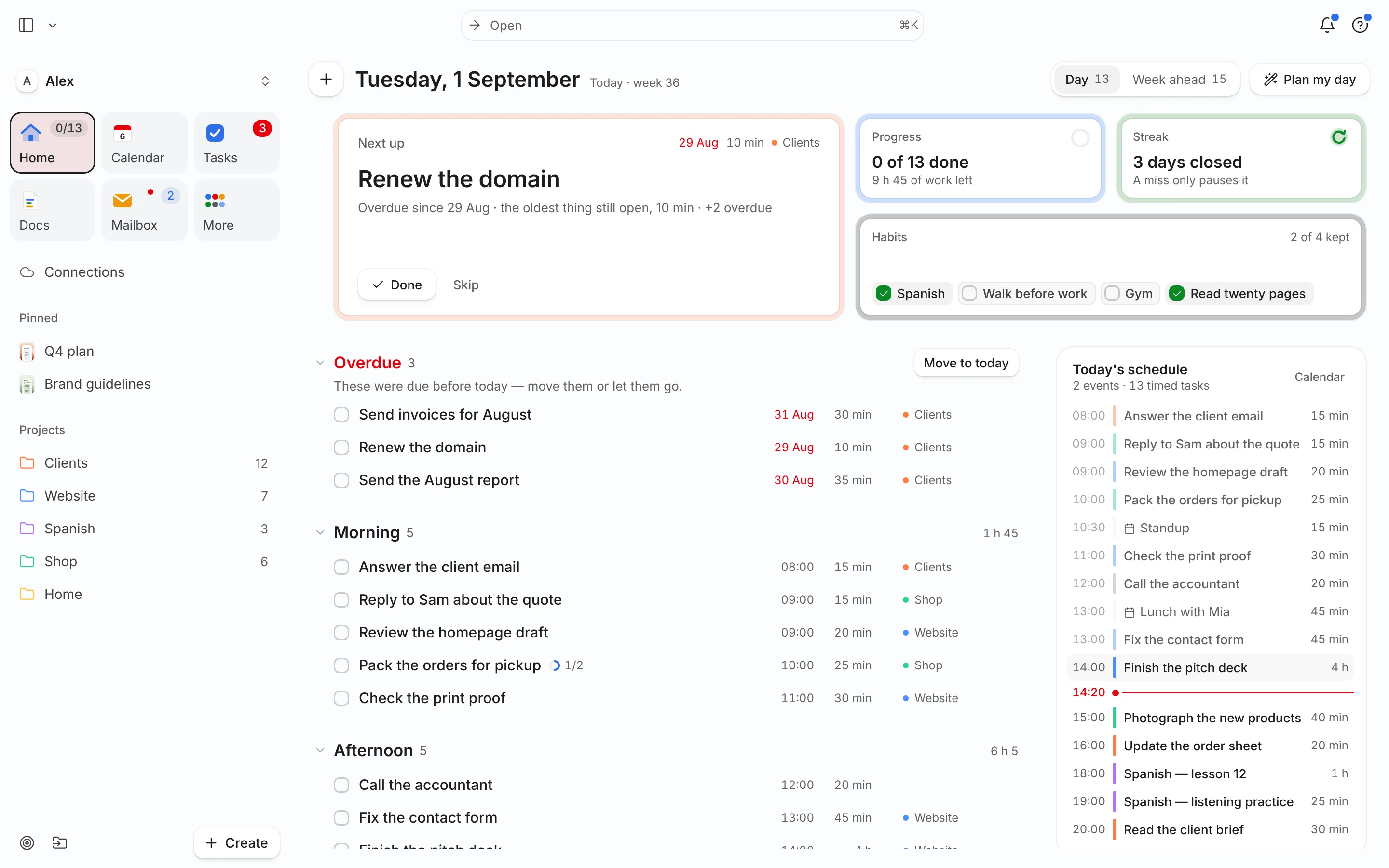
Most daily plans fail the same way. They’re written for the day you wish you had — every task at its best-case length, no gaps, no surprises — and by 11 am the day you actually have has stopped matching.
Every plan runs long
Psychologists call it the planning fallacy. In a classic 1994 study, Roger Buehler and colleagues asked students when they’d finish their theses. The average prediction was 33.9 days. The average actual time was 55.5 days.[1] The same pattern held for small academic and everyday tasks: estimates of about five days, real times closer to ten.
Two details from that research are useful. First, people weren’t over-optimistic about other people’s deadlines — the bias is about ourselves. Second, the gap shrank when people were made to connect the new estimate to how long similar things had taken them before.
Then there’s the other half of the problem, stated by C. Northcote Parkinson in 1955: “Work expands so as to fill the time available for its completion.”[2] Give a task the whole afternoon and it will take it. Underestimate and you run over; leave it open and it sprawls.
The five-minute routine
The fix isn’t a better app or a longer planning session. It’s a few small habits, each backed by something you can look up.
1. Empty your head (one minute)
Write down everything that’s pulling at you — not just today’s tasks. Unfinished goals keep surfacing as intrusive thoughts; Masicampo and Baumeister found that simply making a concrete plan for them made those thoughts go away.[3] You don’t have to do it all. You have to know where it is.
2. Break the big ones down (one minute)
“Finish the deck” is not a task, it’s a project. Listing the steps — outline, numbers, slides, review — makes estimates more honest. Kruger and Evans showed that this kind of “unpacking” reduces the planning fallacy.[4]
3. Estimate, then add half (one minute)
Put a duration on every task, and check it against the last time you did something similar. Then add a buffer. In Buehler’s data, real times ran roughly 1.6 to 1.9 times the estimate, so multiplying by 1.5 is still generous to yourself.
4. Give each task a slot (one minute)
Put the tasks on your calendar, around the meetings you already have. If they don’t fit, that’s the most useful thing the plan will tell you all day: decide now what moves to tomorrow, rather than discovering it at 6 pm.
5. Write one if-then (one minute)
For the task that matters most, decide the trigger: “When I’m back from lunch, I open the report and nothing else.” Across 94 studies, plans in this if-then form had a medium-to-large effect on actually reaching goals (d = 0.65).[5]
The day that doesn’t fit
Step four is where most plans break, because fitting tasks around meetings by hand is fiddly, and redoing it when a meeting moves is worse. It’s also the step that software is genuinely good at.
In Needt you write tasks the way you’d say them — “send the report, 30 min, by Friday” — and they get a slot in your free time, around your calendar. When a call runs over or a meeting moves, the rest of the day rebuilds and shows you what changed. You still make the decisions; you stop doing the arithmetic.
Plan the day you have, not the day you wish you had.
Five minutes in the morning. Honest estimates, a buffer, a slot for everything, and one if-then. It won’t make the day shorter. It will make it the one you planned.
Sources
- Buehler, Griffin & Ross, “Exploring the ‘Planning Fallacy’: Why People Underestimate Their Task Completion Times”, JPSP 67(3), 1994. doi.org
- C. Northcote Parkinson, “Parkinson’s Law”, The Economist, November 1955. doc.cat-v.org
- Masicampo & Baumeister, “Consider It Done! Plan Making Can Eliminate the Cognitive Effects of Unfulfilled Goals”, JPSP 101(4), 2011. doi.org
- Kruger & Evans, “If you don’t want to be late, enumerate: Unpacking reduces the planning fallacy”, JESP 40(5), 2004. doi.org
- Gollwitzer & Sheeran, “Implementation Intentions and Goal Achievement: A Meta-analysis of Effects and Processes”, 2006. doi.org