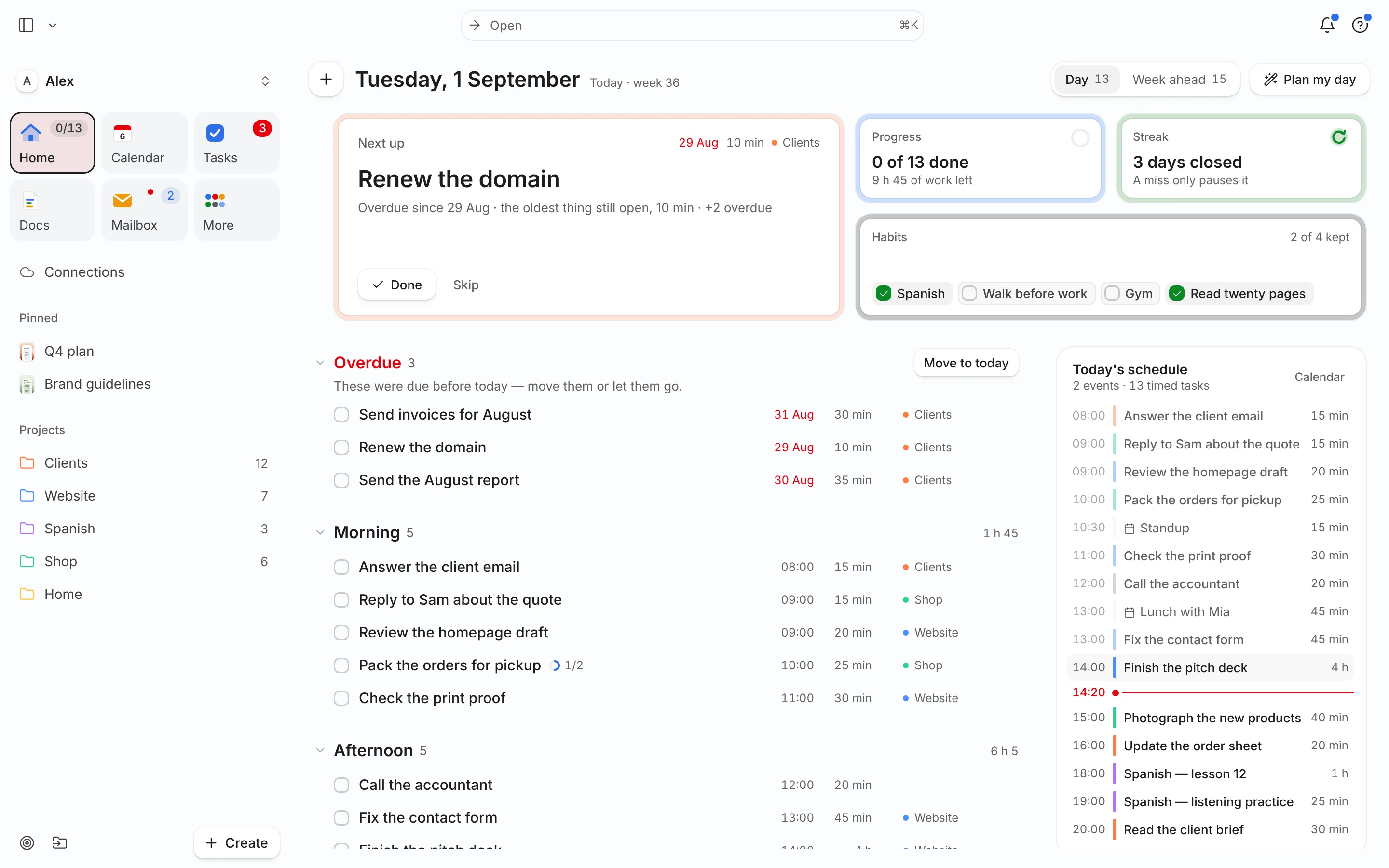


Open your laptop and count the places your day lives. Tasks in Todoist. Notes in Notion. Meetings in Google Calendar. The ask that started half of it, somewhere in Gmail. The references, on a Pinterest board. None of these apps is bad. The trouble is the walking between them.
The two-second tax
In 2022, researchers writing in Harvard Business Review tracked how people at large companies moved between applications during the workday. The average person toggled between apps and websites around 1,200 times a day.[1] Each switch took a little over two seconds to reorient — trivial on its own, and just under four hours a week in total, roughly 9% of the year’s working time.
Four hours is half a working day, every week, spent finding your place again. And that is only the cost a stopwatch can see.
The cost you don’t see
Gloria Mark’s group at UC Irvine has been watching people work since the early 2000s. In a 2005 study they found that people spent about 11 minutes on a piece of work before switching to something else, that 57% of those pieces were interrupted, and that when interrupted work was picked up again the same day, it took on average 25 minutes to get back to it — with more than two other tasks in between.[2]
A switch isn’t a clean cut, either. Sophie Leroy called it attention residue: when you leave a task unfinished, part of your mind stays with it, and you do worse on the next one.[3] Mark’s later work found that interrupted people compensate by working faster — and pay for it in stress, frustration and effort.[4]
The app you’re in isn’t the problem. The four you’re keeping an eye on are.
More tools, more switching
The numbers keep climbing. Asana’s 2023 Anatomy of Work index put the average knowledge worker at 8.8 apps, and found that people juggling the most apps were the most likely to miss messages and actions.[5] Microsoft’s 2025 Work Trend Index counted 275 interruptions a day from meetings, email and chat — about one every two minutes of core hours.[6]
Planning suffers first. A plan that lives in three places is three plans, and they disagree: the calendar says you’re free at 3, the task list says the report is due today, the doc you need is in a fourth tab you closed on Monday.
Fewer places, not more willpower
The usual advice is discipline: batch your email, close your tabs, turn off notifications. It helps. But the cheaper fix is structural — make fewer places where your day can hide.
- One list of what’s open. Tasks from every project in one view, with an estimate on each.
- That list on the calendar. A task without a slot is a wish. A task with a slot is a plan you can check against the clock.
- Notes next to the work. The doc for a task should be one click from it, not a search away.
- A plan that moves when the day moves. When the 2 pm runs over, the rest should shift without you dragging blocks around.
Why we built Needt this way
Needt puts tasks, calendar, docs and boards in one place, and plans the day for you: tasks get slots, the slots respect your meetings, and when something moves, the rest of the day rebuilds. You can still connect Google, Outlook or iCloud calendars and your mail — they just stop being separate places you have to visit.
You won’t get the four hours back all at once. But every switch you don’t make is two seconds, and a little residue, you keep.
Sources
- Murty, Dadlani & Das, “How Much Time and Energy Do We Waste Toggling Between Applications?”, Harvard Business Review, 2022. hbr.org
- Mark, González & Harris, “No Task Left Behind? Examining the Nature of Fragmented Work”, CHI 2005. www.ics.uci.edu
- Leroy, “Why is it so hard to do my work? The challenge of attention residue when switching between work tasks”, OBHDP 109(2), 2009. doi.org
- Mark, Gudith & Klocke, “The Cost of Interrupted Work: More Speed and Stress”, CHI 2008. ics.uci.edu
- Asana, Anatomy of Work Global Index, 2023. investors.asana.com
- Microsoft, Work Trend Index: Breaking down the infinite workday, 2025. www.microsoft.com